Upper Dolpo Round Trek
Difficulty:
Hiking days: 27 days
Season: Autumn / Spring
L'essentiel du trek
L’Upper Dolpo Round Trekking se déroule dans l’une des régions les plus isolées et préservées du Népal, aux confins de la frontière tibétaine. Longtemps fermée aux étrangers et ouverte au trekking seulement à la fin des années 1980, cette zone reculée offre une expérience rare, réservée aux amateurs de treks d’aventure en haute montagne.
La région du Haut Dolpo est rendue célèbre par le livre The Snow Leopard de Peter Matthiessen et par le film oscarisé Himalaya – Caravan. Elle fascine par son isolement extrême, sa spiritualité et ses traditions profondément ancrées dans la culture tibétaine.
Peu fréquenté en raison de ses cols élevés et de la difficulté du parcours, le Dolpo récompense les trekkeurs par des vallées intactes, des villages traditionnels et des paysages d’une grande diversité, entre forêts de pins et panoramas himalayens spectaculaires. Une aventure exigeante et hors du temps, destinée aux randonneurs expérimentés en quête d’authenticité
Upper Dolpo Round Trek
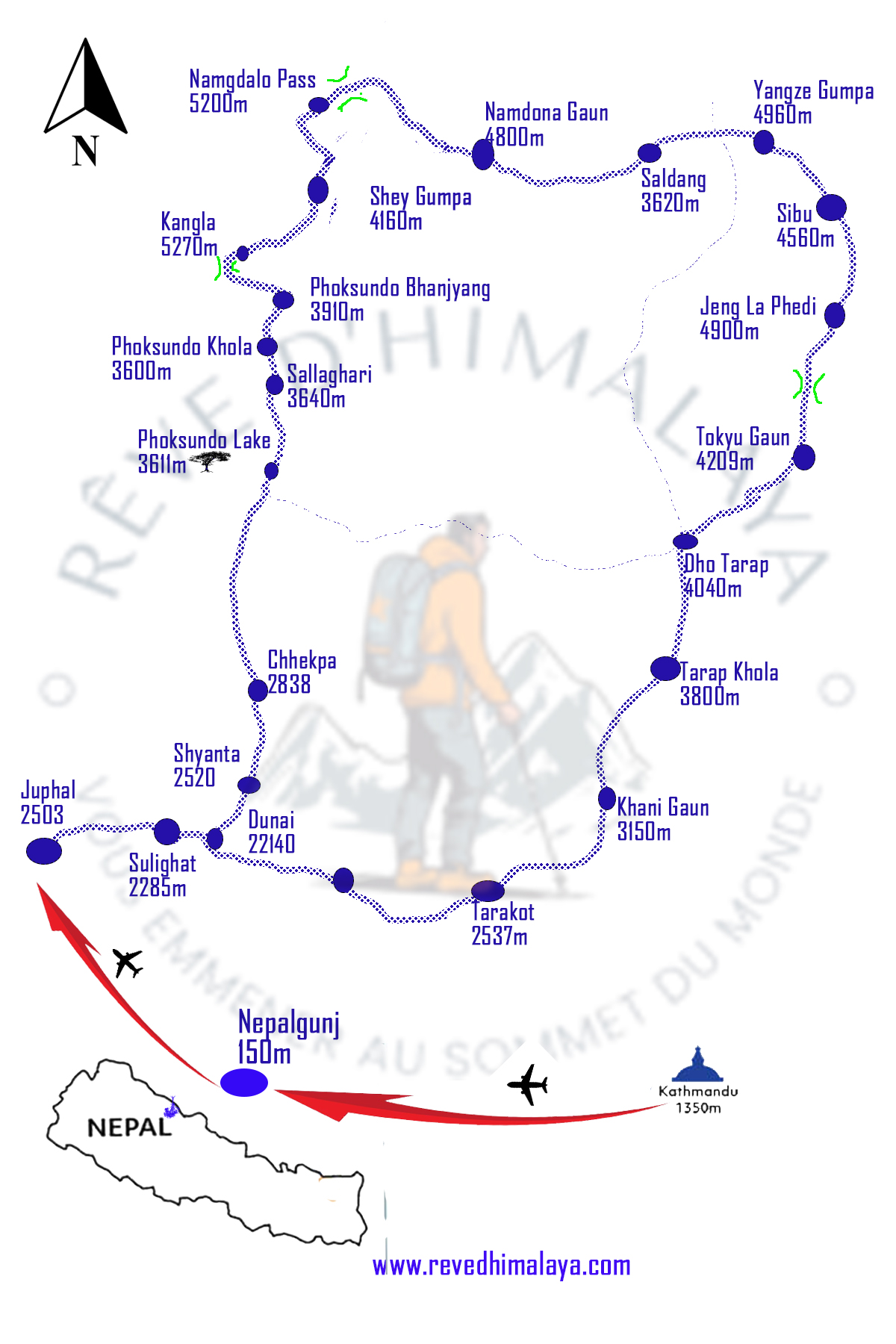
Details Itinerary
Day 01: Arrival in Kathmandu (1300m / 4,264ft)
Upon arrival at the Tribhuwan International Airport (TIA) in Kathmandu, you will be greeted by a representative from Rêve d’Himalaya Trekking. who will take you to your hotel. Overnight stay in Kathmandu (hotel).
Day 02: Kathmandu: sightseeing and trek preparationJour 2 : Katmandou : visite de la ville et préparation du trek
After breakfast we offer a guided tour to a selection of several of the most historical and spiritual attractions in Kathmandu which are also listed as UNESCO World Heritage sites. We can visit the historic Durbar Square, the sacred Hindu temple of Pashupatinath, the famous ‘Monkey Temple’ (Swayambhunath) and Buddhist shrine (Bouddhanath), which hosts also one of the largest stupas in the world. In the afternoon, there will be a pre-trip meeting where you can meet your trek leader and other team members. Rêve d’Himalaya Trekking will brief you regarding details of your trek and provide you with an opportunity to ask any questions you may have on your upcoming adventure. Overnight stay in Kathmandu (hotel).
Day 03: Flight from Kathmandu to Nepalgunj: about 1 hour
After the possibility for a short morning excursion in Kathmandu, you take a 1 hour flight departing early afternoon from Kathmandu to Nepalgunj, a town located in Western Nepal near the Nepal-India border. It is also the gateway to valleys of Simikot, Humla besides Dolpo. The town itself is an interesting Terai settlement that showcases the diverse cultures of Nepal. In Nepalgunj, you visit the local market, a mini-zoo and nearby villages. Overnight stay in Nepalgunj (hotel).
Day 04: Flight from Nepalgunj to Jhuphal (Dolpo) and trek to Dunai (2850m / 9,348ft): 45 min flight, 2-3 hours trek.
Your flight to Jhupal (about 45 minutes) departs after breakfast. The destination town is beautifully located in the Himalayan foothills, with views on the Annapurna and Dhaulagiri peaks in the north. Here, you meet your trekking staff and begin the trek. The trail leads through terraced fields to the Bheri River and its narrow gorge. You continue walking to Dunai, which is the administrative headquarter of the Dolpo region. You explore the small town in the evening. Overnight stay in Dunai (lodge).
Day 05: Dunai to Ankhe (2,896m/9,499ft): 5-6 hours
Day 06: Ankhe to Sulighat (2285m / 7,481ft): 5-6 hours
Your trail follows a wooded riverbank and eventually takes a steep ascent. The route passes by several streams that offer a chance to cool off. You eventually leave the forests and pass through a grassy slope high above the river, before hiking downhill on a section surrounded by lush forests. The trail now consists of wobbly stone path next to the river bank. You continue trekking until you reach Sulighat. Overnight stay in Sulighat (lodge).
Day 07: Sulighat to Phoksundo Lake (3611 m / 11,849 ft): 4-5 hours
You continue following the valley upwards until the confluence of the Phoksundo and Pungmo rivers. After crossing a bridge, you take the western bank of the Pungmo river. The trail passes through a cedar forest before reaching Palam village. From here and as you climb up a ridge you enjoy distant views on Phoksundo Lake and on a spectacular waterfall, one of the highest in Nepal. Next, your trail descends through birch forests to the upper part of the Phoksundo river, before reaching the picturesque Ringmo village with its mud-plastered chortens and mani walls. From here it is a short walk to the shores of the Phoksundo Lake. Overnight stay at Phoksundo Lake (lodge).
Day 08: Acclimatization day and rest at Phoksundo Lake (3 611m / 11,849ft)
Today will be a well-deserved rest day at Phoksundo Lake for acclimatization. You can undertake a short hike to the village of Ringmo and it’s Tibetan Buddhist Monastery. During your exploration of the area, you also get a chance to get acquainted with the local culture. The Dolpo people wear homespun clothing that is sometimes dyed in a maroon color. They favor Tibetan-style somba or dhocha (boots with upturned toes) as foot wear. Both men and women often wear religious amulets and strings of coral, amber and turquoise. Overnight stay at Phoksundo Lake (lodge).
Day 09: Trek to Phoksundo Khola (3600 m / 11,811 ft): 4-5 hours
The trail follows the bank of the Phoksundo Lake until its top western end where a mere rocky ledge is left. The trail takes the form of a suspended gangway made out of wood supported by pegs driven into crevasses of the rocks. This narrow trail emphasises the remoteness of the area which you are about to enter. At the westernmost edge of the lake the path leads through a lush meadow that opens up into the flood plain of the Phoksundo river. You enter the valley, crossing the river and avoiding the occasional boggy marsh, before you reach the firm bank of the river. Overnight stray in Phoksundo Khola (lodge).
Day 10: Phoksunds Khola to Phoksundo Bhanjyang (3910 m / 12,828ft): 6-7 hours
During your trek today you will admire the views of Chhamlang peak 6 (6739 m / 22,109ft) and peak 7 (6105 m / 20,029ft). You start by walking for approximately one hour on a trail that follows a glacial valley, heading north. At the confluence of the Phoksundo river and another mountain stream, there is an old wooden bridge. From here, you walk towards north-east. A long climb brings you to a sheep meadow where your trail enters a steep ravine. A hard climb to the top brings you to yet another valley where you can see the Kang-La pass. Since no lodge exist in this area, we set up a camp near the pass in a place that Peter Matthiessen named ‘Snowfields Camp’. Overnight camping at Snowfields Camp (tent).
Day 11: Phoksundo Bhanjyang via Kang-La pass (5360 m /17,581ft) to Shey Gompa (4500 m /14,760ft): 5-6 hours
In the morning, you climb up towards the pass on a steep trail walking on littered stone plates (slate). The ascent to the top of the pass is quite strenuous. From the top of Kang-la pass you have an excellent view on the large valley dissected by a torrential river. You descend to the bottom of the valley using a steep and meandering trail which follows the banks of a river, crossing and re-crossing it several times. There are mud caves lining up in the hills overlooking the river. You also pass through meadows where you can observe grazing yaks, hundreds of sheep and domestic mountain goats (Chyangra). After crossing an old log bridge you reach the compound of the Shey Gompa monastery. Overnight stay in Shey Gompa (monastery or tent).
Day 12: Acclimatization and rest at Shey Gompa
Today is another well-earned rest day for acclimatization. You can visit Shey Gompa. The Monastery was built in 1655. It is is noted for its giant gold-plated copper statue representing a seated Shakyamuni Buddha.To the east of the monastery lies the Crystal Mountain which is one of the strangest mountains as its twisted cliffs are laced with quartz and embedded with a rich variety of marine fossils. You spend the day hiking around Shey village which is famous for its ancient pre-Buddhist culture, the Bon Po. In Dolpo the ancient Tibetan way of life combines animism with the teaching of Buddha. Overnight stay in Shey Gompa (monastery or tent).
Day 13: Shey Gompa via Saldang La (5200 m /17,056ft) to Namduna Gaun (4800 m / 5,744ft): 6-7 hours
You start the hike amidst juniper trees by following a pleasant trail which enters into a grey, stony canyon. The path begins to zigzag over bare rocks and coarse eroded soil until it eventually brings you to the top of the Saldang-la pass. The subsequent descent towards the north is long and tiring but grazing yaks and sheep, and nomadic tents made from yak hair is a comforting sight. In the village of Namduna Gaun you visit the Namgung monastery. The red-stoned monastery is built against the backdrop of a cliff on the north wall of a gorge. Overnight stay in Namduna Gaun (lodge).
Day 14: Namduna Gaun to Saldang (3620 m / 11,874ft): 4-5 hours
You leave the village and climb up a slope. This is the start of a long walk along dusty barren mountains. After 3-4 hours of hard climb, you will be able to see Saldang village below on a plateau high above the Namga Khola stream. It has a picturesque appearance. Saldang is the largest settlement of the inner Dolpo area. The village stretches for nearly two kilometers on an open slope and consists of five villages having about eighty well-built houses for nearly six hundred people. It is a prosperous village not only agriculturally-wise but also for its strategic location on a trade route to Tibet. Overnight stay in Saldang (lodge).
Day 15: Saldang to Yangze Gompa (4960m/16,267ft): 4-5 hours
From Saldang, you walk further north along the Nagon Khola river on a wild and barren terrain. You begin your hike on a fairly gradual path with few ups and downs. On the way, you pass the Marang and Ki villages. Next, the trail crosses a tributary to the Panzang River and you walk towards the east, crossing the river again before reaching the compound of Yangze gompa which houses an old Bon-Po Monastery. Overnight stay in Yangze Gompa (lodge).
Day 16: Yangze Gompa to Sibu (4560 m /1 4,957ft): 6-7 hours
From Yangze, there are two trails that connect to Sibu. To save time we will retrace the path back towards Saldang village, which will be much easier and shorter than the other route. From Saldang we walk along a river and pass through terraced fields, stupas, chortens, mani stones. You reach the Chaiba monastery, then pass through Namdo village, which is also prosperous, with about sixty houses and nearly 400 inhabitants. It stretches for more than 5 km on the high slopes on the left bank of Nam Khong river. The Namdo monastery is located near the river bed. Our journey continues further down the river with another two hours hike to a camp near the small settlement of Sibu. Overnight stay in Sibu (lodge).
Day 17: Sibu to Jeng-la Phedi (4900 m / 16,072ft): 5-6 hours
Your trek follows the Nam Khong river for a while. You are likely to encounter caravans with yaks that are travelling towards the Tibetan border. After turning east and walking for a while, you reach the confluence of two small streams. Next, the trail ascends steeply towards a grazing area below the Jeng La pass (4900 m / 16,072ft). Overnight stay in Jeng-la Phedi (tent or lodge).
Day 18: Jeng-la Phedi via via Jeng La pass (5,090 m / 16,695ft) to Tokyu Gaon (4209 m / 13,809ft): 5-6 hours
We get up early in the morning. During two long hours the trek will take you to reach the top of the Jeng La pass from where you catch remarkable views of the north face of the Dhaualgiri massif. You descend a rough trail to the Tarap Valley, a fascinating area with vast plains framed by high mountains that align over twenty kilometers along Tarap Chu river. You reach he village of Tokyu Gaon. Overnight stay at Tokyu Gaon (lodge).
Day 19: Tokyu to Dho Tarap (4040 m / 13,251ft): 4-5 hours
The trail takes you downhill towards a plain valley with patches of lush grass on both sides of the river – a complete change compared to other parts of inner Dolpo. There is also a marsh which is a common feature in the desert mountains of Tibet and the Ladakh region of Himalaya. Both the Bon Po and Buddhist sects are located in the valley. After a short trek, you reach Dho Tarap. Overnight stay in Dho Tarap (lodge).
Day 20: Rest Day at Dho Tarap (4040 m / 13,251ft):
You spend a day resting and strolling in the village of Dho Tarap which is surrounded by an irregular stone wall. As you walk around you will inevitably get acquainted with the local culture of the area. At Dho Tarap, the about 40 houses are grouped in three clusters. They house a few Tibetans and mostly Magars (hill tribe of Nepal) inhabitants. You can visit a Buddhist monastery which is close to the village or you can chose to take a 40-minute walk and visit a Bon Po monastery. Overnight stay in Dho Tarap (lodge).
Day 21: Dho Tarap to Tarap Khola (Kamakharka) (3800 m / 12,464ft): 6-7 hours
From Dho Tarap you descend towards a wide valley which eventually narrows into a gorge. You walk along juniper and wild rose bushes just above the tree line. On our trek you will see herds of blue sheep. In the afternoon, you reach further east the confluence of the Tarap Chu and the Lang rivers. Overnight stay as Tarap Khola (lodge).
Day 22: Tarap Khola to Khanigaon (3150 m /10,332ft): 4-5 hours
You continue walking down the gorge of the Tarap River, at times close to it. While hiking you pass by local people who are guiding their herds to the lower pastures for the winter period. This will be one of the most exciting days of this trip as the valley ends in a deep gorge so narrow that in some places one can jump from one side to the other. Sometimes there is no trace of a path and you may have to walk across stone plates fitted on logs between the gorge walls and acting as a bridge. The gorge also provides unexpected adventure and thrills: At some places, the bridges are either damaged or washed away and you may be forced to cross the icy torrent barefoot. Finally, you reach Khanigaon village. Overnight stay at Khanigaon (lodge).
Day 23: Khanigaon to Tarakot (2537 m / 8,321ft): 4-5 hours
From the village you follow a trail that takes you to the village of Lalberi. The trail then passes through a lush forest, descends into another gorge and continues to follow the river. After reaching Tarakot located at the confluence of the Barbung and Tarap Chu rivers. You can visit the monastery of Sandul Gompa which lies about 8 km east of the village. The monastery stands on a hill to the south of the Bheri river. Overnight stay in Tarakot (lodge).
Day 24: Tarakot to Dunai (2,140 m /7,019ft): 5-6 hours
Today’s trek will mostly be through a wonderful gorge with pine trees. You begin your trek on a trail behind the Bheri River before crossing a bridge near Lawan village. Your trail will continue alongside the big Bheri river, until you reach the bastion of Byas Gadi. From here the trail moves towards the west and becomes relatively easy. You cross the river again near the village of Lochakhola Gaon and ascend to reach Dunai from where your round trek departed. Overnight stay in Dunai (lodge).
Day 25: Dunai to Jhuphal (2475 m / 8,129ft): 2-3 hours
From Dunai, you trek along the Bheri River enjoying the beautiful landscape. On the way, you pass through Dhupichaur village and reach Rupgad village with a hindu temple. You continue trekking via Kalagaonda village and Motipur village before reaching the small airstrip of Jhuphal. Overnight in Jhuphal (lodge).
Day 26: Fly from Jhuphal to Nepalgunj and then to Kathmandu
We take the earliest flight from Jhupal to Nepalgunj from where we return to Kathmandu on the next available flight. After arriving in Kathmandu, you will be transferred to your hotel. There is nothing left but to exchange email adresses with travel companions and organize the photos. To celebrate the successful completion of your journey, we will have a farewell dinner hosted by Rêve d’Himalaya Trekking. Overnight stay in Kathmandu (hotel).
Day 27: Final departure
Our adventure in Nepal comes to an end today! A representative from Rêve d’Himala Trekking will take you to the airport where you have to register approximately 3 hours before the scheduled departure.
Informations utiles :
Difficulté : Difficile
Jours de marche : 27 jours
Saison : Automne et Printemps
Prêt à réserver votre trek ?
N’hésitez pas à me contacter pour réserver ce trekking ou obtenir plus d’informations !